W34 CSTGIA 2026: Cyber Decision Advantage
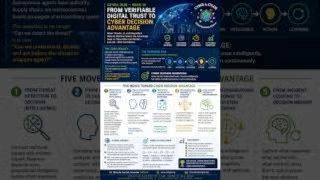
### From Verifiable Digital Trust to Cyber Decision Advantage When Threats Move at Machine Speed, Knowing More Isn't Enough. What if the biggest cybersecurity advantage isn't seeing the threat first—but deciding what to do about it first? In Week 34 of CSTGIA 2026, we take the next step in our journey from Verifiable Digital Trust to Cyber Decision Advantage. Today's cyber environment is increasingly difficult to govern at human speed. AI is accelerating both attack and defense. Autonomous systems are gaining greater authority. Digital supply chains are increasingly interconnected. And organizations are processing more alerts, intelligence, data, and signals than ever before. Yet more information does not automatically produce better decisions. An organization can have sophisticated dashboards, threat intelligence, predictive analytics, AI copilots, and thousands of alerts—and still make the critical decision too late. That is why this week's session focuses on Cyber Decision Advantage: the organizational ability to sense earlier, understand faster, choose intelligently, act within trusted boundaries, verify outcomes, and learn continuously. We explore five important shifts for the next era of cyber leadership: 1\. Threat Detection → Decision Intelligence Connect technical signals with mission impact, business dependencies, risk, policy, and operational consequences. 2\. AI Assistance → Human\-AI Decision Teams Use AI for machine-speed analysis while preserving human context, ethics, judgment, creativity, and accountability. 3\. Static Playbooks → Adaptive Decision Boundaries Clearly define what autonomous systems can do, what requires human approval, when escalation occurs, and how authority can be overridden or revoked. 4\. Organizational Response → Ecosystem Decisions Coordinate intelligence and decisions across suppliers, partners, cloud providers, technology platforms, government, and other interconnected stakeholders. 5\. Incident Lessons → Decision Memory Capture not only what happened, but what was known, what was missed, what decisions were made, and what should improve the next time. This week's challenge is to choose one high-consequence cyber scenario, an AI-agent compromise, ransomware event, software supply-chain attack, identity compromise, insider threat, cloud disruption, or major data breach—and map the complete decision chain: SIGNAL → CONTEXT → INTELLIGENCE → OPTIONS → DECISION → AUTHORITY → ACTION → VERIFICATION → LEARNING Then ask: Where does our decision chain slow down, become unclear, or lose accountability? Identify one point of decision friction and improve it this week. The future of cybersecurity will not be defined simply by who possesses the most data, tools, automation, or AI. It will increasingly be defined by who can see sooner, understand faster, decide better, act confidently, and learn continuously. When threats move at machine speed, knowing more isn't enough. You have to know what to do next. #CSTGIA #CSTGIA2026 #Cybersecurity #CyberDecisionAdvantage #ArtificialIntelligence #AgenticAI #CyberLeadership #DigitalTrust #CyberResilience #AIGovernance #HumanAI #DecisionIntelligence #CyberStrategy #FutureOfCybersecurity 🎥 **Watch on YouTube:** https://youtu.be/KGbGYa1MARg If you enjoy this content, please Like, Subscribe, and Share to help others prepare for the future of cybersecurity, leadership, and digital transformation. 🔔 New episodes of CSTGIA 2026 are released weekly, exploring the emerging trends, technologies, leadership strategies, and enterprise capabilities shaping the future of cybersecurity and organizational excellence. #CSTGIA #Cybersecurity #AgenticAI #AutonomousAI #DigitalTrust #AIAssurance #ZeroTrust #AIGovernance #CyberResilience

